SHARKSPLOITATION AND THE USE OF THALASSOPHOBIA IN FILM
When people think about danger and water, two things will always surface: drowning and sharks.
And honestly, sharks just hit different. No other animal gets under our skin in quite the same way, and filmmakers know it. After Jaws (1975) tore through the collective psyche, nobody wanted to go anywhere near the ocean. Overnight, the sea went from a tranquil holiday postcard to raw nightmare fuel, and just like that, shark movies were everywhere. They all run on the same basic idea: the ocean is beautiful, but it is also terrifying, and nothing sums that up better than a shark.
Jaws did more than kick off a genre. It lodged sharks deep in our subconscious and tapped into a primal fear that goes all the way back to our evolution as a species. I’ll circle back to that in a minute, but first it is worth looking at the sharksploitation boom that followed in its wake.

JAWS (1975) - Peter Benchley & Carl Goddlieb
The real shift came when filmmakers realised realism was optional. You did not need biology or plausibility to scare people. All you needed was a shark. Once that door opened, anything was on the table. Mutant sharks, ghost sharks, giant sharks, sharks in tornadoes. If it sounded ridiculous, someone probably greenlit it somewhere down the line.
You can see this shift clearly in Deep Blue Sea (1999). Where Jaws thrived on restraint and grounded tension, Deep Blue Sea goes full balls-to-the-wall 90s. It is loud, knowingly stupid, and gloriously camp. Super-smart mutant sharks, wild science fiction, and a tone that winks at the audience the whole way through. In one savage bite, shark movies pivoted from tense realism to slick, self-aware spectacle.

Deep Blue Sea (1999) - Duncan Kennedy, Donna Powers & Wayne Powers
The genre did not stop there. The Shallows (2016) swings the pendulum back in the other direction. It strips everything down to the basics: Blake Lively, injured and alone, versus one particularly nasty shark. The film is intimate and tense, using tight framing to make the open ocean feel claustrophobic and hostile. Where Deep Blue Sea is excess,The Shallows is restraint. No mutants, no gimmicks, just survival and a CGI shark that still holds up.
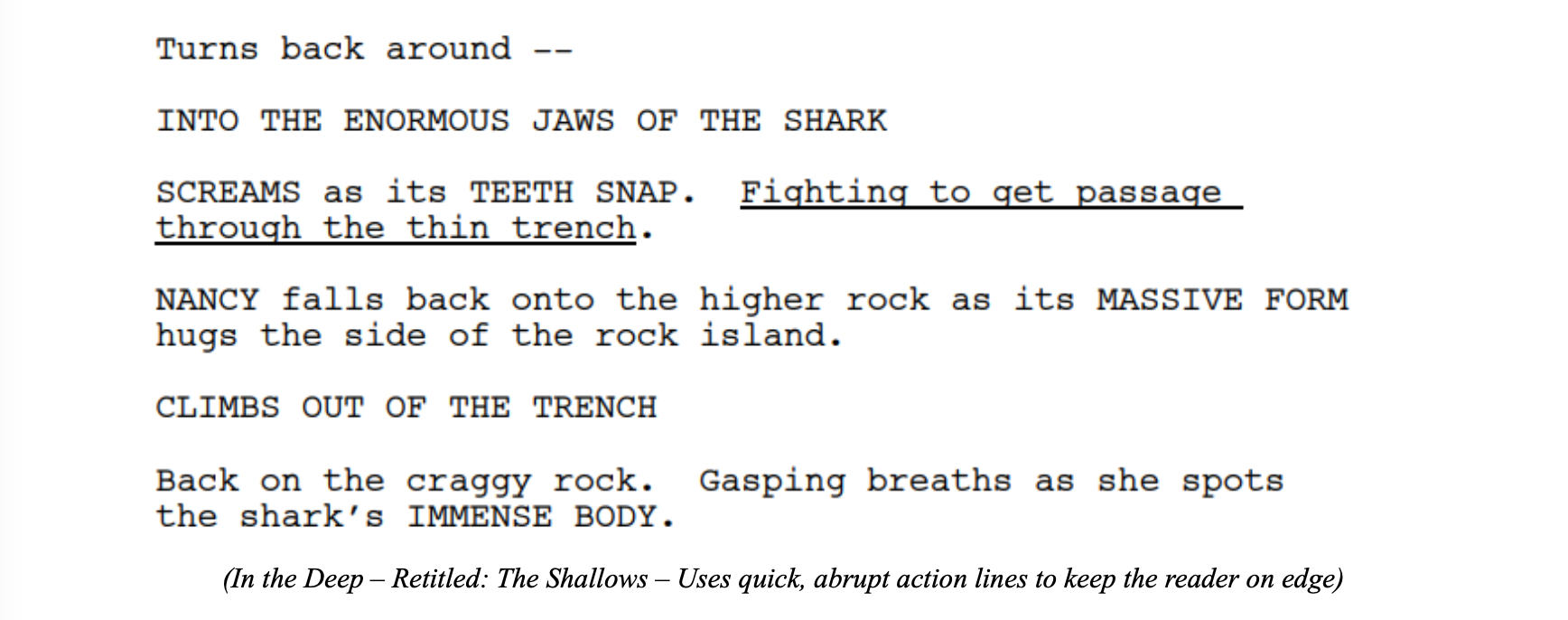
The Shallows (2016) - Anthony Jaswinski
47 Meters Down (2017) takes yet another approach. Instead of scale or action, it leans hard into psychological terror. Two sisters are trapped in a shark cage on the ocean floor, running out of air. The vast sea becomes a suffocating prison. Their choices are brutally simple: drown, suffocate, or swim through a pack of great whites and hope for the best. Where Deep Blue Sea is chaotic and The Shallows is solitary, 47 Meters Down is pure claustrophobic dread.
Not every shark movie aims to scare. Some go completely off the rails. Sharknado (2013) turned the genre into a punchline, throwing flying sharks, chainsaws, celebrities, and spectacularly bad CGI into a blender. Its success proved that shark movies could fully embrace absurdity and still find an audience. That opened the floodgates for cult “classics” like Ghost Shark (2013), House Shark (2017), and Trailer Park Shark (2017), to name just a few.
Other filmmakers got creative within tight budgets. Bait (2012) traps a shark inside a flooded supermarket during a robbery, wringing tension out of its confined setting. Open Water (2003), based on a true story, strands a couple in the open sea after a diving trip goes wrong. The sharks are barely seen, which only makes it worse. Its raw realism and slow-burn anxiety make it one of the genre’s most unsettling entries.
Then came The Meg (2018), which cranked everything up to eleven. Jason Statham versus a seventy-five-foot megalodon. Based on Steve Alten’s delightfully unhinged novels, it leans fully into classic monster-movie territory with a glossy modern sheen. Critics were divided, but audiences ate it up. The film is not interested in subtlety or existential dread. It is pure spectacle. But whether restrained or ridiculous, all shark movies tap into the same fear: being hunted in a vast, alien world where humans are not in control.
A more recent entry, Beast of War (2025), revisits familiar territory but does so with a confident bravado. Set during World War II, it follows Australian soldiers whose ship sinks in the Timor Sea. Stranded on a life raft, they must survive exposure, internal conflict, and a massive great white circling below.
What sets Beast of War apart is its hybrid approach. It blends war thriller with shark horror, grounding the story in real history by referencing the 1942 sinking of the HMAS Armidale. The shark, largely realised through wonderful practical effects, is terrifying, but it is also symbolic. It becomes another manifestation of war’s brutality. No surfers, no tourists, just soldiers trapped between human violence and nature’s indifference. The setting refreshes the genre, but the core remains the same: survival, predator versus prey, and the ocean as the ultimate threat.
To understand why all of this works, you have to look beneath the surface. Thalassophobia is the fear of deep water, not just of drowning or sharks, but of the ocean itself. Vast, empty, and utterly hostile to human life. In ocean-horror films, this fear is not background flavour. It is the main antagonist. The sea becomes the villain. Ancient, cold, and completely uncaring. And honestly, the ocean is a fucking terrifying place.
Thalassophobia feeds on the unknown. We still do not really know what is down there. The deep sea remains largely unexplored, which makes it perfect for horror. Films like The Abyss (1989) and Sphere (1998) hide alien, world-ending threats beneath the waves because, to us, the ocean already feels alien.
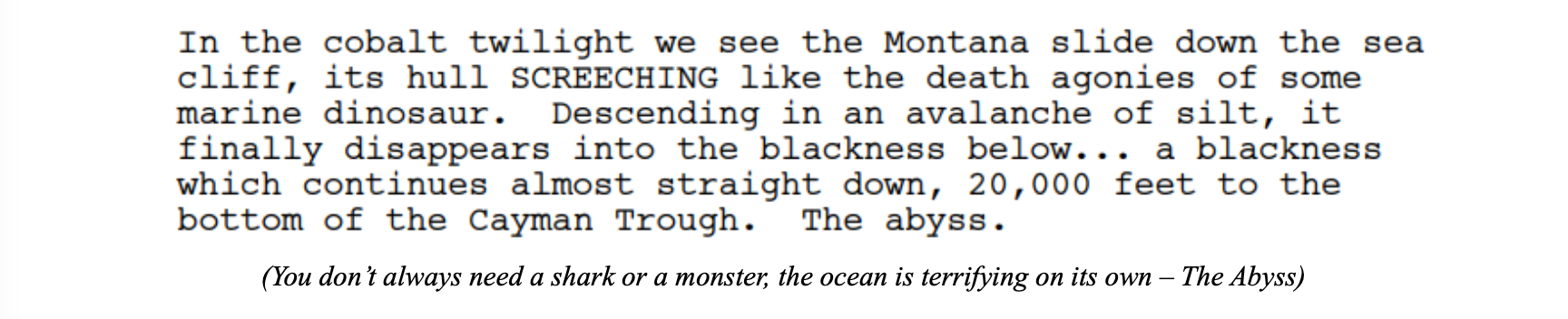
The Abyss (1989) - James Cameron
Even when realism gives way to monsters or pulp thrills, thalassophobia is doing the heavy lifting. In films like Deep Rising (1998) or The Meg, the creatures are frightening not just because they are large, but because they emerge from a place we cannot see or control. The ocean can hide anything, and that possibility is scarier than any single monster.
This fear also shapes how characters behave. Isolation and helplessness breed paranoia and desperation. The Deep House (2021) combines underwater exploration with haunted-house horror, and much of its tension comes from the environment itself. Every breath is counted. Every movement is slow and deliberate. The crushing pressureof the water mirrors the characters’ psychological collapse. One mistake is all it takes to die horribly.
Filmmakers reinforce thalassophobia through craft. Wide shots emphasise emptiness. Close-ups turn diving suits and helmets into prisons. Murky lighting conceals threats. Sound design does the rest: muffled audio, groaning metal, sudden silence. The ocean is not just dangerous, it feels ancient and unknowable.
More recently, ocean horror has folded in environmental themes. Films like The Beach House (2019) and Sea Fever (2019) explore pollution, disease, and climate collapse, adding a layer of ecological dread to thalassophobia. Here the sea is not just hostile, it is sick and this shit is highly contagious.
The ocean is beautiful, but it is massive, cold, and does not give a single shit about us. Horror films that tap into thalassophobia do not need elaborate plots or excessive gore. All they need is the suggestion that something is waiting below, and our imagination fills in the rest.
Thalassophobia is closely related to fear of the dark, but they are not the same. Thalassophobia is about depth and exposure. It feels like being lost in space, only wet and freezing. You are vulnerable from every angle, with nowhere to hide and a cold infinity engulfing you.
Fear of the dark is more intimate. It is about proximity. Darkness removes certainty and replaces it with possibility. A shadow could be anything. A corner could hide something unspeakable. This fear is rooted in childhood, when sight meant safety. The dark is not vast, it is close, and that makes it sinister.
Both fears emerge when our senses fail. In the ocean, visibility disappears. In darkness, it is gone entirely. Thalassophobia makes you feel insignificant and alone. Fear of the dark makes you feel trapped and watched.
Horror uses these fears differently. Thalassophobia excels at slow, suffocating survival stories. Silence, pressure, and empty space do the work. Fear of the dark hits faster, perfect for jump scares, haunted spaces, and relentless tension, but easily vanquished with the flick of a light switch or the strike of a match.
Ultimately, they are reflections of the same ancient instinct. A reminder that what we cannot see can still hurt us. And sometimes, the most terrifying thing of all is not knowing what is out there, watching, and waiting, infinitely patient in the dark void.
Written by Lee Bentley